

· Max Lowery · Podcast Episode · 9 min read
#111 Victoria lost 30lbs, but that's not what changed her life...
What if lasting weight loss has nothing to do with dieting? Victoria shares how she overcame emotional eating, lost 30 pounds, and transformed her life by healing the deeper issues that were keeping her stuck.
🎧 Prefer to listen on the go? Click on the podcast episode below!
Your current privacy settings prevent us from loading and showing you this embedded podcast.
From Dieting to Food Freedom: How Victoria Lost 30 Pounds by Healing Emotional Eating and Changing Her Life
What if the reason you can’t lose weight has nothing to do with willpower?
If you’ve tried every diet, explored intuitive eating, and still feel stuck, this episode could completely change the way you see your weight loss journey.
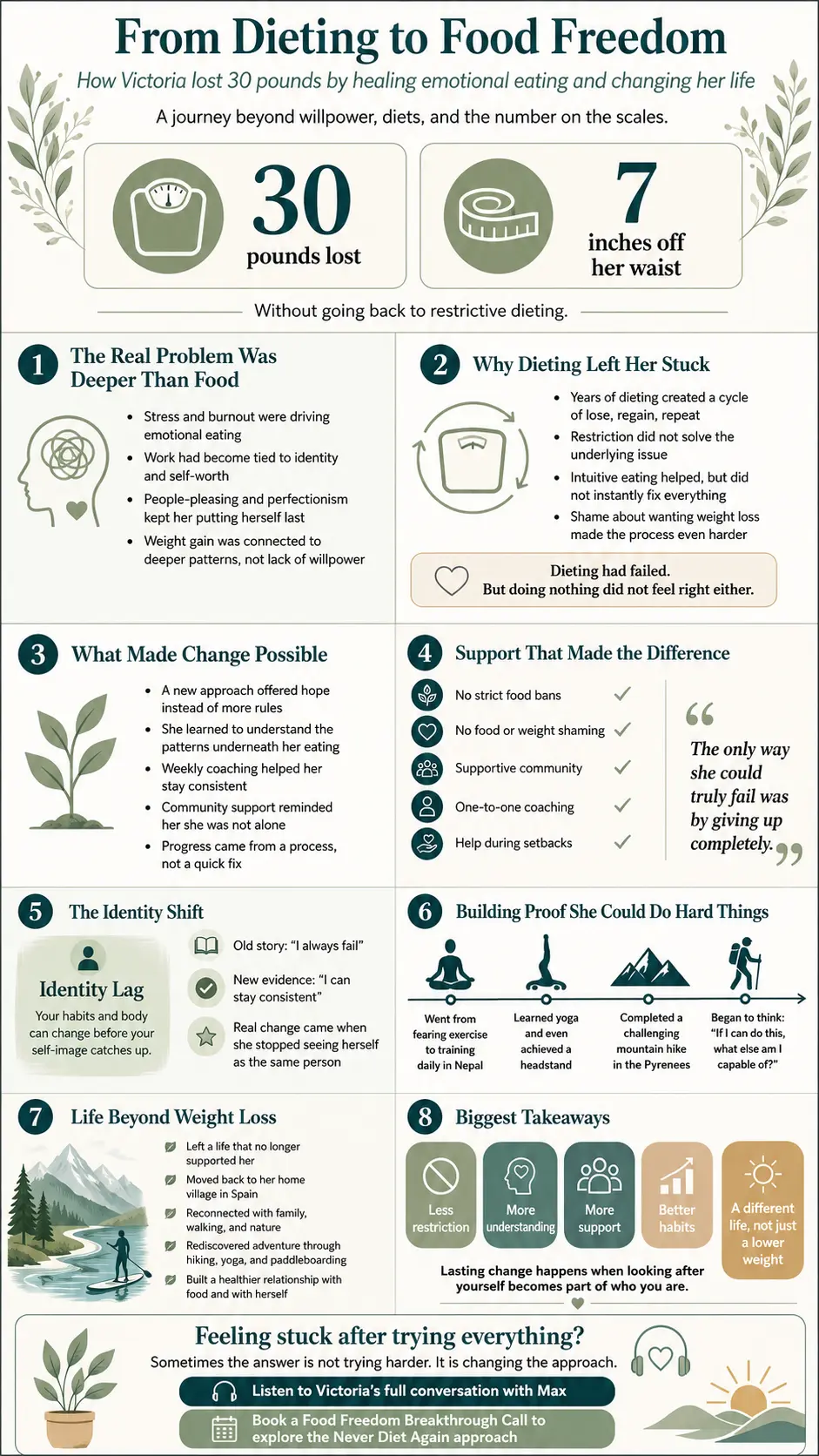
In this powerful conversation, Max sits down with Live 360 client and mentor Victoria, who shares how she went from years of dieting, emotional eating, and frustration to losing 30 pounds and 7 inches from her waist, without going back to restrictive diets.
But this episode isn’t really about the weight loss.
It’s about discovering that weight gain can sometimes be connected to something much deeper. Together, Max and Victoria explore how stress, burnout, people-pleasing, perfectionism, low self-worth and long-standing habits had influenced Victoria’s relationship with food for years.
In This Episode, You’ll Hear
Why years of dieting left Victoria feeling stuck
Why moving towards intuitive eating did not immediately solve the problem
How stress and work became closely connected to food
Why Victoria was convinced she might be the one person the programme would not work for
How weekly coaching and community support helped her keep going
Why changing her identity became as important as changing her habits
How she rediscovered movement through yoga, hiking and adventure
Why lasting change became about much more than a number on the scales
When Dieting Stops Working — But You Still Want Change
Victoria had spent years trying different diets.
Like many women, she would lose some weight, regain it, try something else and find herself back in the same place.
Eventually she realised restriction was not helping.
She started learning more about nutrition and intuitive eating. That helped her move away from the constant diet cycle, but it created another problem.
She still did not feel comfortable in herself.
Victoria describes reaching a point where she even felt some shame about wanting to lose weight.
She knew she did not want another restrictive diet.
But she did not want to simply accept feeling unhappy either.
This is the gap Max sees many women fall into.
They know dieting has failed them.
They also know something still needs to change.
What they often do not know is what to do instead.
That was the position Victoria was in when she discovered one of Max’s podcast episodes.
She describes it as a small “spark of hope”.
For the first time, she heard an approach that seemed to offer a middle ground.
Why Intuitive Eating Can Feel So Difficult After Years of Dieting
One important part of their conversation is the idea that intuitive eating is not always something you can simply decide to start doing.
Years of dieting can leave you disconnected from hunger, fullness and trust around food.
You may have spent years:
Restricting certain foods
Ignoring hunger
Labelling foods as “good” or “bad”
Starting again every Monday
Feeling guilty when you eat something you believe you should not
Max explains that the long-term goal is for clients to build more trust around food.
But that can take time.
It is a process rather than a switch.
For Victoria, that meant learning to understand what was happening underneath her eating patterns rather than simply trying to control them again.
The Hidden Link Between Work Stress and Emotional Eating
As Victoria progressed through the programme, she began looking beyond food.
One of the biggest areas was work.
Victoria had built a successful career and received several promotions.
On the surface, things looked good.
But work had gradually become a huge part of her identity.
Being busy felt like proof that she was successful.
Being able to cope with everything became a badge of honour.
She describes always saying yes, taking on more responsibility and putting other parts of her life second.
That had a direct impact on food.
A difficult day could become:
“I deserve a takeaway.”
Being busy could become:
“I don't have time, so I'll just grab something.”
Stress gave her both a reason to eat and a reason not to look more closely at what was happening.
That realisation was important.
The food was not necessarily the whole problem.
It had become one way of coping with a life that no longer supported her.
People-Pleasing, Perfectionism and Putting Yourself Last
Victoria also began recognising patterns such as people-pleasing.
She wanted to be the person who could handle everything.
The reliable one.
The successful one.
The person who never needed a break.
At one stage she had even felt proud that she had not taken a sick day in ten years.
Eventually, however, the pressure caught up with her.
She describes getting to the point where she would find herself crying during the working day and feeling unlike the strong, resilient person she believed herself to be.
This was when a bigger question emerged:
Was the life she had created actually supporting the person she wanted to become?
That question eventually led to a major change.
Victoria left her job.
She sold her house.
And she moved back to her home village in Spain.
Importantly, Max makes it clear in the episode that this does not mean everybody needs to make dramatic life changes.
The lesson is simpler.
Sometimes change begins by asking difficult questions.
What is working?
What isn't?
What can you control?
Where are you constantly putting yourself last?
Why Support Made Such a Difference
Victoria admits she was sceptical before joining Live 360.
Part of her wondered whether it was simply another diet dressed up differently.
Another part wondered whether she would fail again.
In fact, she repeatedly told her coaches that she thought she might be the one person it would not work for.
What helped was having people who believed change was possible before she fully believed it herself.
Victoria highlights several things that felt different:
No strict rules banning certain foods
No food or weight shaming
A supportive community
Other women sharing both wins and struggles
Regular one-to-one coaching
Help when problems appeared instead of being left to figure everything out alone
That ongoing support became especially important during periods when she wanted to give up.
One idea stayed with her:
The only way she could truly fail was by giving up completely.
So she kept going.
30 Pounds Lost — But That Was Only Part of the Change
During the episode Victoria shares that she has lost 30 pounds and around 7 inches from her waist.
She also describes a much bigger shift in how she feels.
Previously she would walk into shops and avoid mirrors.
Now she enjoys shopping again.
She feels good in her clothes.
And she no longer sees herself in exactly the same way.
That matters because physical change can sometimes happen faster than your self-image changes.
Max describes this as “identity lag.”
You may already be behaving differently.
You may already have built new habits.
You may already have evidence that you can do things you previously thought were impossible.
But part of your mind may still be working from the old story:
“I'm someone who always fails.”
“I can't stay consistent.”
“I'll eventually go backwards.”
For Victoria, changing that story became a major part of her progress.
Building Evidence That You Can Do Hard Things
One of the clearest examples came through exercise.
Victoria previously describes having almost a fear of exercise.
Later, she travelled to Nepal to complete a month-long yoga teacher training course.
At first, even she wondered what she had got herself into.
She went from avoiding exercise to doing several hours of movement each day.
Gradually things changed.
She became stronger.
She began enjoying it.
She even learned to do a headstand — something she previously would have assumed was impossible.
But an even bigger moment happened during a Live 360 retreat in the Pyrenees.
Victoria took part in a challenging mountain hike.
Beforehand, she imagined herself struggling at the back and possibly not being able to finish.
Instead, partway up the mountain, she realised:
“I can do this.”
It wasn't simply positive thinking.
She now had evidence.
She had trained.
She was climbing.
Her body was doing something she previously did not believe she could do.
And that led to a much bigger question:
If I can do this, what else am I capable of doing?
From Weight Loss to Building a Different Life
After leaving her previous job, Victoria initially thought she would immediately fill her time with travelling and new experiences.
Instead, she realised she needed some time to slow down.
She spent time with family in Spain.
She walked.
She explored the mountains.
Eventually she travelled to Nepal.
She trained as a yoga teacher.
She started hiking.
She tried paddleboarding.
She became more adventurous.
In her words, she began rediscovering a side of herself that had existed when she was younger but had somehow disappeared along the way.
That is why Victoria's story goes far beyond weight loss.
The original goal may have been to change her body.
The deeper result was beginning to change the way she treated herself and the kind of life she wanted to live.
The Biggest Lesson From Victoria's Story
Perhaps the most powerful moment comes near the end of the conversation.
Victoria says she is no longer afraid that she will eventually return to her old habits and regain everything.
That fear has faded because she no longer feels like the same person who started the programme.
She has built evidence.
She has worked through difficult moments.
She has changed her relationship with food.
She has become more active.
She has learned to put herself higher on her own priority list.
And she has continued even when part of her wanted to stop.
That is very different from following a diet temporarily.
A diet asks:
“What rules should I follow?”
A deeper approach asks:
“What needs to change so looking after myself becomes part of who I am?”
For Victoria, that question changed far more than her weight.
If You Feel Like You've Tried Everything
Victoria once believed she might be the exception.
The person who simply couldn't change.
Years of failed diets had given her plenty of evidence to support that belief.
Her experience shows why the answer is not always trying harder.
Sometimes it means changing the approach completely.
Less restriction.
More understanding.
More support.
Better habits.
More awareness of the patterns driving your choices.
And enough time to build evidence that another way of living is possible.
Ready to stop dieting and understand what may really be keeping you stuck?
Listen to Victoria's full conversation with Max.
And if you would like personalised support, you can book a Food Freedom Breakthrough Call to learn more about the Never Diet Again approach and whether it could be right for you.