

· Max Lowery · Podcast Episode · 7 min read
#109 The Link Between ADHD, Emotional Eating & Menopause Nobody Talks About with Will Fraser
Why are so many women over 40 being diagnosed with ADHD during menopause? In this episode, Max and meditation coach Will Fraser explore the link between ADHD, emotional eating, dopamine, and nervous system regulation
🎧 Prefer to listen on the go? Click on the podcast episode below!
Your current privacy settings prevent us from loading and showing you this embedded podcast.
Do you feel like your brain never switches off?
If you’re constantly overwhelmed, stress eating, procrastinating, scrolling your phone, or struggling to stay focused during perimenopause or menopause, this episode could explain why.
In this powerful conversation, Max sits down with meditation coach and former school leader Will Fraser to explore the growing connection between ADHD, emotional eating, dopamine, and nervous system dysregulation especially in women over 40.
Key Takeaways
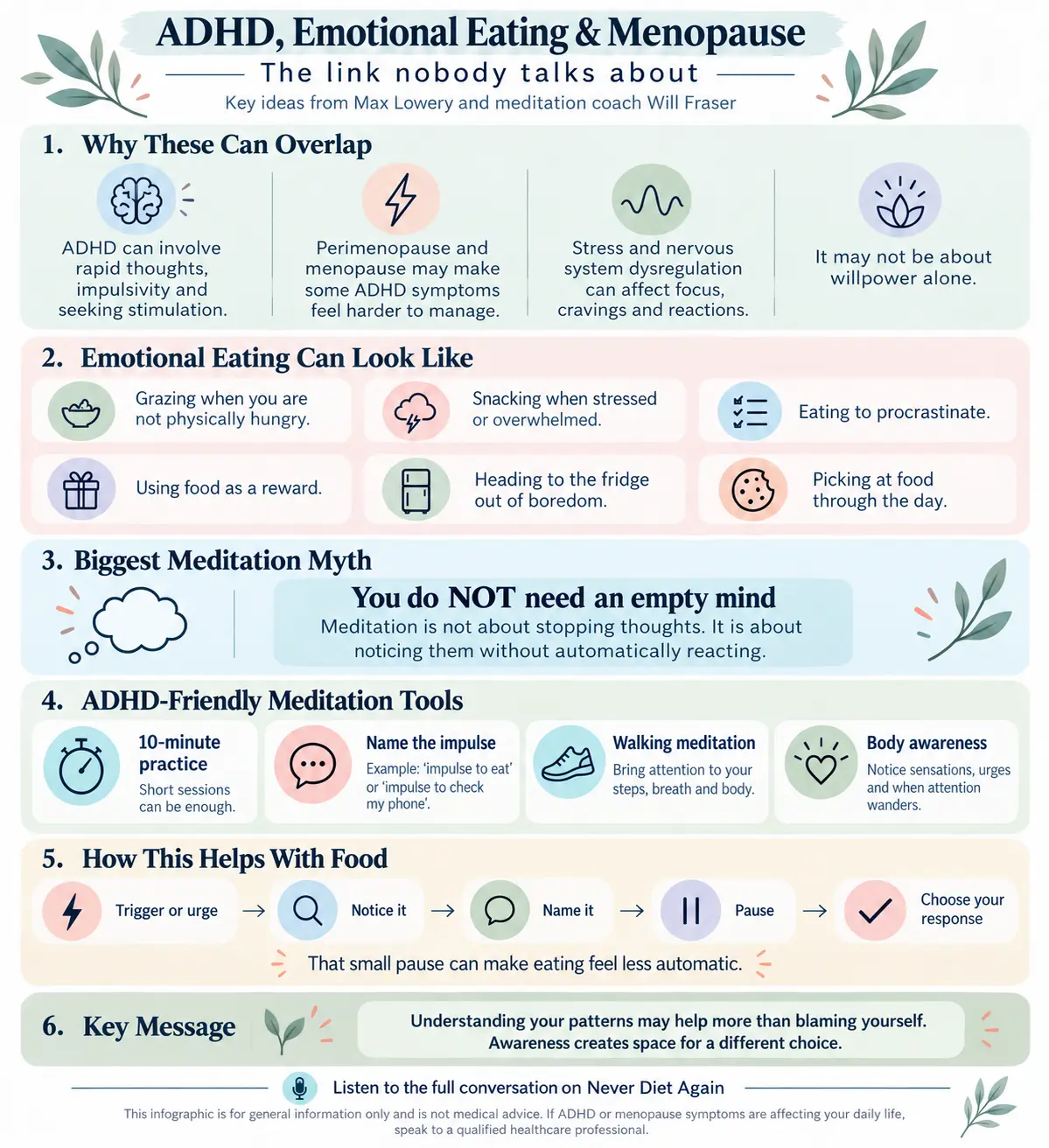
ADHD can involve rapid thoughts, impulsivity and constantly seeking stimulation.
Emotional eating can be much more subtle than binge eating. It may look like grazing, snacking, procrastination eating or eating as a reward.
Meditation is not about stopping your thoughts. It is about noticing them without automatically reacting.
Short practices, walking meditation and simple mindfulness exercises may feel more accessible than long periods of sitting still.
Naming an urge — such as an impulse to eat or check your phone — can help create a pause before acting on it.
The episode explores why understanding your patterns may be more useful than simply blaming a lack of discipline or willpower.
Many women are being diagnosed with ADHD later in life, often during perimenopause, when hormone changes can make symptoms worse. But here’s the surprising part: many of the behaviors women blame themselves for impulsive eating, sugar cravings, lack of focus, emotional overwhelm, all-or-nothing thinking may not be about willpower at all.
Will shares his personal journey with ADHD and explains why meditation is one of the most effective tools for improving focus, emotional regulation, and impulse control. And no meditation does not mean sitting still with an empty mind.
In this episode, you’ll learn:
Why ADHD symptoms often increase during perimenopause and menopause
The hidden link between dopamine, emotional eating, and phone addiction
Why women with ADHD often feel exhausted, overstimulated, and stuck in fight-or-flight mode
How meditation helps regulate the nervous system and reduce impulsive behavior
Why “I can’t meditate because my brain is too busy” is actually the biggest myth
Simple ADHD-friendly meditation techniques you can start using today
How mindfulness creates space between your emotions and your eating habits
Why ADHD, Menopause and Emotional Eating Can Overlap
During the episode, Max discusses research he had been reading around ADHD in women, later diagnosis and reports of symptoms becoming more noticeable during perimenopause.
For somebody who already has ADHD, changes during this stage of life may make challenges around focus, emotional regulation and impulsivity feel harder to manage.
That can also matter when it comes to food.
Will talks about his own experience of constantly seeking stimulation, while Max explores how this can overlap with eating behaviours, scrolling and other quick sources of reward.
That doesn't mean every woman who feels overwhelmed, distracted or impulsive has ADHD. These experiences can have many causes.
If you think you may have ADHD or symptoms are affecting your daily life, diagnosis and treatment should be discussed with an appropriately qualified healthcare professional.
Emotional Eating Doesn't Always Look Like Binge Eating
One of the most useful parts of the episode is Max's explanation of what emotional eating can actually look like.
Many people imagine someone eating a tub of ice cream after a breakup.
But that isn't the only form it can take.
It can also look like:
Picking at food when you aren't physically hungry
Grazing throughout the day
Heading to the fridge because you're bored
Eating to avoid starting something difficult
Snacking when you're stressed or overwhelmed
Using food as a reward after a difficult day
That distinction matters because these behaviours can become automatic.
You may know you aren't hungry.
Part of you may even be thinking, I don't really need this.
Yet you still find yourself reaching for the food.
Max and Will discuss why increasing awareness of that moment may help create more choice around what happens next.
Meditation Isn't About Having an Empty Mind
Will says one of the biggest misconceptions about meditation is that you have to completely switch off your thoughts.
You don't.
Thoughts appearing does not mean you have failed at meditation.
In fact, noticing that your attention has wandered is part of the practice.
Will describes meditation as learning to observe what your mind is doing without immediately becoming caught up in it.
Max describes something similar from his own mindfulness practice.
His mind can quickly move towards:
What's next?
What do I need to do?
What happens if I don't get this done?
The aim isn't necessarily to stop those thoughts from appearing.
It is to notice them.
That little bit of distance can create space between a thought, emotion or impulse and what you decide to do next.
And that is where the conversation becomes particularly relevant to emotional eating.
The Simple “Name the Impulse” Technique
Will shares a simple technique he uses when working with attention and impulsivity.
Instead of immediately responding to an urge, notice it and give it a name.
For example:
“Impulse to check my phone.”
Or:
“Impulse to get something to eat.”
Or:
“Impulse to stand up.”
Rather than arguing with the impulse or criticising yourself for having it, you simply notice that it is there.
Will says he finds this acknowledgement helps reduce the grip the impulse has over him.
For somebody who often reacts automatically, this can create a small but important pause.
The aim is not perfection. It is greater awareness of what is happening.
You Don't Have to Meditate Sitting Still
Another useful misconception Will challenges is the idea that meditation means sitting cross-legged and staying completely still.
One of his favourite approaches is walking meditation.
Rather than sitting down, you bring your attention towards what your body is doing while you walk.
You might notice:
Your feet touching the ground
The movement of your ankles and knees
Your breathing
Physical sensations in your body
When your attention wanders
For somebody who finds movement easier than sitting still, Will says this can be a much more approachable way of practising mindfulness.
He also discusses body-scan exercises and very short mindfulness techniques that can be used throughout normal life.
The full episode goes deeper into these methods and how Will uses them himself.
Small Moments of Awareness Can Matter Around Food
This is where the techniques discussed in the episode become particularly relevant to emotional eating.
Max explains that many of his clients already know what they believe they "should" eat.
The difficult part is what happens during stress, boredom, overwhelm or strong emotion.
Food can become an automatic response.
Mindfulness gives you an opportunity to notice what is happening before immediately reacting.
You may still decide to eat the food. The difference is that the decision can become more conscious rather than completely automatic.
For Max, this is one reason mindfulness and nervous system regulation form part of the wider work around emotional eating.
What If Your Brain Feels Too Busy to Meditate?
A busy mind is not necessarily a reason to avoid meditation.
Will's point is that noticing your attention wandering is part of the practice.
You notice it.
Then you gently bring your attention back.
He recommends keeping the process realistic rather than expecting yourself to suddenly meditate for long periods.
And if sitting still feels particularly difficult, approaches such as walking meditation, body awareness and short mindfulness exercises may feel more accessible.
His main message is simple: don't expect perfection straight away.
What This Means for Women Struggling With Food After 40
The point of this conversation isn't that ADHD causes every struggle with food.
Nor is meditation being presented as a replacement for ADHD treatment or medical care.
The useful idea is to look more closely at what happens before the behaviour.
Stress, impulsivity, emotion, habit and the search for stimulation can all influence the choices we make.
Becoming more aware of those patterns may give you a little more space before automatically reaching for food, checking your phone or reacting to stress.
That shift from automatic reaction to greater awareness is one of the main themes running through Max and Will's conversation.
Listen to the Full Conversation
If you struggle with emotional eating, sugar cravings, stress snacking, overthinking, overwhelm or simply feel as though your brain is constantly switched on, this episode offers a different way to think about those patterns.
Max and Will go much deeper into ADHD, attention, dopamine, phone use, meditation, nervous system regulation and emotional eating during the full conversation.
Listen to the full episode now, and if you want personalised support, book your Food Freedom Breakthrough Call today.
Find out more about Will Fraser here:
www.mind-beyond-matter.com