

· Max Lowery · Podcast Episode · 11 min read
#110 How Your Inner Critic Is Sabotaging Your Weight Loss
What if your weight loss struggles have nothing to do with food? In this episode, Max explores how your inner critic fuels emotional eating, cravings, and self-sabotage and shares a simple framework to help you break the cycle and build lasting food freedom.
🎧 Prefer to listen on the go? Click on the podcast episode below!
Your current privacy settings prevent us from loading and showing you this embedded podcast.
How Your Inner Critic Is Sabotaging Your Weight Loss (And What to Do About It)
What if your biggest weight loss struggle has nothing to do with food?
What if the real problem is the critical voice in your head that keeps telling you you're failing?
In this powerful episode, Max Lowery explores the connection between your inner critic, emotional eating, cravings and the frustrating cycle of trying to lose weight only to feel as though you have failed again.
If you've ever found yourself reaching for biscuits, chocolate, wine or snacks after a stressful day — then criticising yourself afterwards — this episode will help you understand what may be happening underneath that pattern.
Many women over 40 believe they need more willpower, more discipline or a stricter diet.
But Max argues that the real battle often isn't a lack of nutrition knowledge.
It's the conversation taking place inside your own head.
In This Episode, You'll Discover
Why negative self-talk can make emotional eating harder to manage
How childhood experiences and social pressures can shape your inner critic
Why knowing what to eat isn't always enough to create lasting change
How stress and self-criticism can become part of an emotional-eating cycle
Why your thoughts don't automatically have to become facts
How CBT and Acceptance and Commitment Therapy approach difficult thoughts differently
Max's four-step process: Awareness, Acceptance, Assimilation and Action
Why small actions can gradually build genuine self-trust
The Person You Speak to Most Is Yourself
Max starts the episode with a simple question:
Who do you spend the most time talking to every day?
You might immediately think of your partner, children, friends or colleagues.
But the real answer is yourself.
From the moment you wake up until you go to sleep, there is usually some kind of internal conversation happening.
For many women, that conversation can become harsh.
Thoughts may sound like:
"What's wrong with me?"
"I've done it again."
"I've got no willpower."
"I knew I wouldn't stick to it."
"I've ruined everything."
When thoughts like these have been running in the background for years, it becomes easy to stop noticing them.
They simply start to feel normal.
Yet Max makes an important point:
You probably wouldn't speak to someone you love the way you sometimes speak to yourself.
Many of the women he works with are kind, caring and supportive towards everybody around them.
But when it comes to themselves, they can become their own harshest critic.
Why Knowing What to Eat Isn't Always Enough
After working with thousands of women, Max has noticed something important.
Many women struggling with food already know a surprising amount about nutrition.
They know protein is useful.
They know vegetables are healthy.
They know movement matters.
They often understand calories.
So simply giving them more food information doesn't necessarily solve the real problem.
Because knowledge isn't always what is stopping them.
The difficulty can be consistently acting on that knowledge when stress, self-doubt, exhaustion and long-standing eating patterns get involved.
If you repeatedly tell yourself:
"I'm a failure."
"I'll never change."
"I can't trust myself."
those thoughts can start to influence what you expect from yourself.
Eventually an opinion can begin to feel like a fact.
And once you expect yourself to fail, it becomes much harder to approach change with confidence.
Where Does Your Inner Critic Come From?
One of the most useful ideas in the episode is that your critical inner voice may not have started with you.
Max discusses a psychological idea known as introjection.
In simple terms, we can absorb beliefs, attitudes and messages from the people and culture around us.
Think about childhood.
Maybe you heard comments about weight.
Maybe a teacher embarrassed you.
Maybe you were bullied.
Maybe you watched a parent constantly criticise their own body.
Maybe you repeatedly heard messages such as:
"Be careful what you eat."
"You'd look better if you lost weight."
Or perhaps nobody said anything directly to you.
You simply watched how the adults around you behaved.
Children absorb an enormous amount from their environment.
They do not always have the ability to step back and ask whether those messages are fair, accurate or useful.
Over time, the original speaker can disappear.
But the message remains.
Max says he has coached women in their sixties who can still remember comments made about them when they were children.
Society can reinforce these messages too.
Women can feel pressure to be thinner, younger, more attractive, more productive and more successful.
Eventually, you may no longer need another person criticising you.
You have learned to do it yourself.
Your Thoughts Are Not Automatically Facts
This leads to one of the central ideas in the episode.
Max shares a quote commonly attributed to Carl Jung:
“Until you make the unconscious conscious, it will direct your life and you will call it fate.”
The important point isn't the quote itself.
It's the idea behind it.
You cannot change a pattern you cannot see.
If the thought "I'm a failure" appears and you immediately accept it, it influences your emotions and behaviour.
But there is another possibility.
You can notice that you're having the thought that you're a failure.
That sounds like a tiny difference.
But psychologically it can create valuable distance.
Instead of:
“I'm a failure.”
You might notice:
“I'm having the thought that I'm a failure.”
The thought is still there.
But you are no longer treating it automatically as a fact.
The Inner Critic and Emotional Eating Cycle
This is where Max connects the inner critic to eating behaviour.
Imagine you've had a difficult day.
You haven't slept particularly well.
Work has been stressful.
Other people have needed things from you.
You've made decisions all day.
You're tired.
Then you look in the mirror and start criticising yourself.
You might think this harshness will motivate you.
Max argues that it often does the opposite.
Instead of helping you feel calm and capable, it adds another layer of emotional pressure.
By the evening, food can become one of the quickest and easiest ways to switch off.
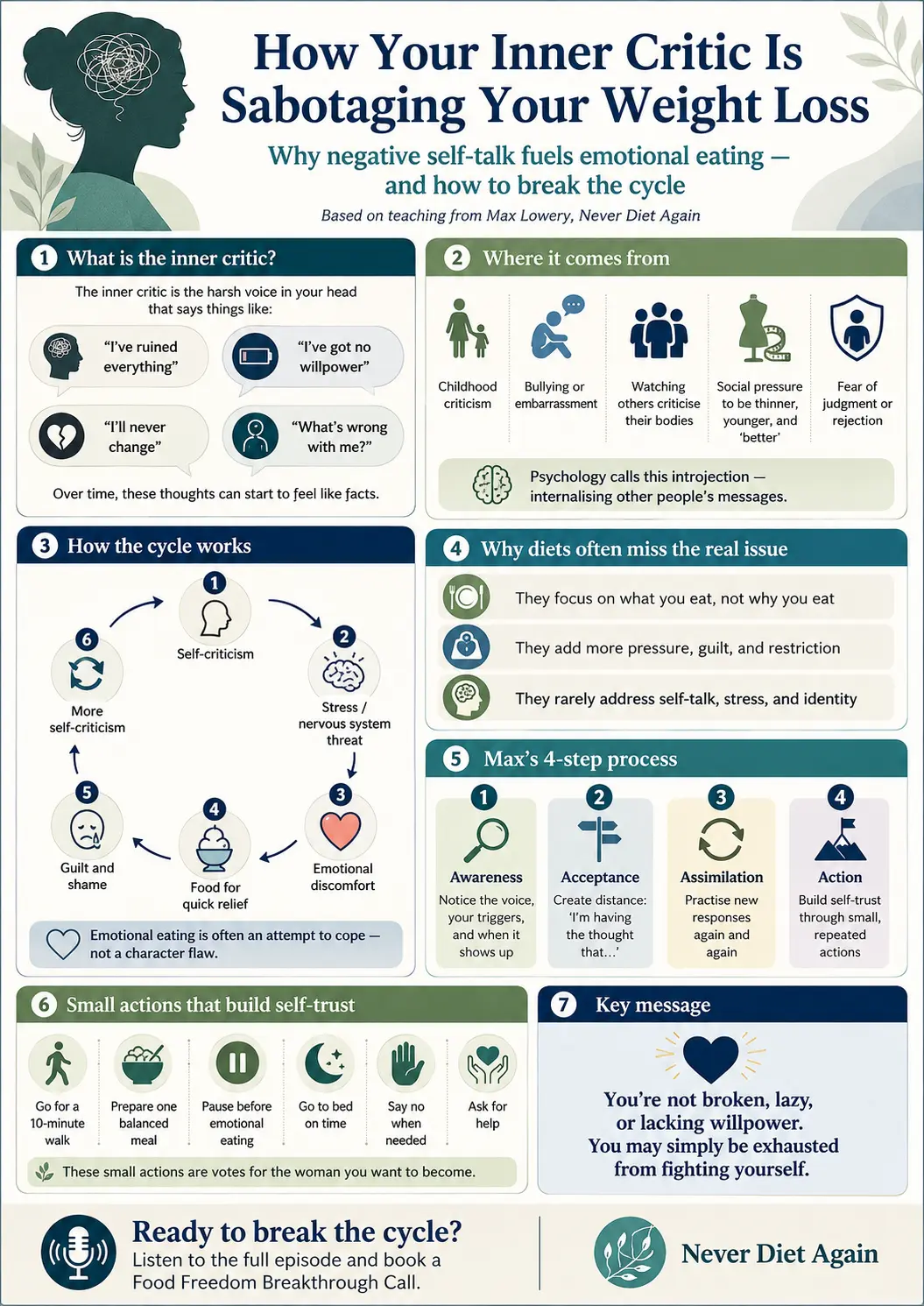
The cycle can look like this:
Self-criticism
↓
More stress and uncomfortable emotion
↓
Desire for relief
↓
Food provides short-term comfort
↓
Guilt afterwards
↓
More self-criticism
↓
The cycle starts again
This is important because traditional diets often focus almost entirely on the food.
They tell you what to eat.
What not to eat.
How many calories to consume.
How many steps to walk.
But they may never ask:
What was happening immediately before you wanted the food?
Was it exhaustion?
Stress?
Loneliness?
Resentment?
Boredom?
Overwhelm?
Self-judgement?
If you only look at the biscuit, chocolate or glass of wine, you can miss the emotional pattern that came first.
Emotional Eating Isn't a Character Flaw
Max offers another way to look at emotional eating.
Rather than simply seeing the behaviour as evidence that you have no self-control, ask:
What was the food helping me cope with in that moment?
Food can provide short-term comfort.
It can distract.
It can give you something pleasurable at the end of a difficult day.
That doesn't mean emotional eating is necessarily helpful long term.
And it doesn't mean you simply accept the pattern and do nothing.
It means you stop treating the behaviour as proof that there is something fundamentally wrong with you.
That creates room to become curious.
Instead of:
“Why am I so useless?”
try:
“What happened before I wanted to eat?”
That question is far more useful.
Why the 'Start Again Monday' Cycle Keeps Repeating
Many women recognise this pattern.
A difficult evening happens.
You eat more than you planned.
You feel guilty.
The following morning you decide:
“Right. That's it. I'm starting again.”
You become stricter.
You try to be perfect.
You control everything for a few days.
Then life happens again.
You're tired.
Something goes wrong.
You get criticised.
You have an argument.
The scales don't show the number you hoped for.
And suddenly you're back where you started.
The problem is that the underlying pattern never changed.
The same emotional triggers remain.
The same inner dialogue remains.
The same all-or-nothing thinking remains.
Each repeat of the cycle can then strengthen another belief:
“See? I knew I couldn't do it.”
Eventually, behaviour starts influencing identity.
You stop thinking:
“That didn't work.”
and start thinking:
“I'm someone who can't do this.”
That distinction matters enormously.
You Don't Need to Eliminate Negative Thoughts
One of the biggest mistakes people make with mindset work is believing the goal is to stop thinking negatively.
It isn't.
You're human.
You will have uncomfortable thoughts.
You will doubt yourself sometimes.
You will have difficult days.
Trying to force yourself to think positively all the time can create another form of pressure.
Max instead teaches clients to change their relationship with their thoughts.
That is where his four-step framework comes in.
Max's Four-Step Process for Dealing With Your Inner Critic
1. Awareness
First, notice the voice.
Don't immediately try to fix it.
Don't criticise yourself for having the thought.
Simply become curious.
Ask:
What does my inner critic say?
When does it appear?
What tends to trigger it?
Does it appear around mirrors?
The scales?
Food?
Stress?
Social situations?
Awareness creates a pause.
And that pause gives you a choice.
Instead of immediately becoming the thought, you can notice:
“There's that voice again.”
That simple moment of observation is important.
2. Acceptance
Max explains two different approaches used in psychology.
Cognitive Behavioural Therapy, or CBT, often helps people examine whether a thought is accurate and replace it with something more balanced.
For example:
“I've ruined everything.”
could become:
“I had one difficult evening. That doesn't erase everything else I've done.”
Max also discusses Acceptance and Commitment Therapy, commonly known as ACT.
ACT takes a slightly different approach.
Instead of arguing with every thought, you can create distance from it.
Instead of:
“I'm a failure.”
try:
“I'm noticing that my mind is telling me I'm a failure.”
This technique is often described as cognitive defusion.
The point isn't to pretend the thought doesn't exist.
It's recognising:
A thought is something happening in your mind. It isn't automatically who you are.
Max suggests using curiosity too.
One simple phrase is:
“That's interesting.”
That's interesting — that thought appeared when I stepped on the scales.
That's interesting — my inner critic got louder after a stressful meeting.
That's interesting — I started wanting food when I finally sat down tonight.
Curiosity is much more useful than judgement.
3. Assimilation
Understanding something once isn't enough.
You need repetition.
If you have spent decades automatically believing the same inner voice, one podcast or journal exercise isn't likely to undo the habit immediately.
You need practice.
Notice.
Pause.
Observe.
Choose.
Then repeat.
Questions Max recommends include:
“Is this thought useful?”
“Is it helping me become the woman I want to become?”
“Is this criticism helping me make a better choice?”
You don't have to wait for the thought to disappear before doing something positive.
You can doubt yourself and still go for a walk.
You can feel stressed and still prepare a balanced meal.
You can experience a craving and pause before responding.
You can feel uncomfortable and still choose what happens next.
4. Action
This is where Max believes self-trust is really built.
Not through endlessly telling yourself how confident you are.
Through evidence.
Every time you keep a small promise to yourself, you create evidence.
A ten-minute walk.
Preparing lunch.
Going to bed when you said you would.
Stopping to think before eating emotionally.
Asking someone for help.
Setting a boundary.
These actions may look small.
But they challenge the old story.
The old story says:
“I can't trust myself.”
The evidence gradually says:
“Actually, I'm starting to follow through.”
The old story says:
“I always give up.”
New evidence says:
“I kept going this week even when it wasn't perfect.”
That is how identity begins to change.
Small Actions Are Votes for Your New Identity
This is one of the strongest ideas from the episode.
Your habits are not only actions.
They also provide evidence about the kind of person you believe yourself to be.
Go for the walk.
Prepare the meal.
Get to bed.
Drink the water.
Ask for help.
Set the boundary.
None of these actions needs to be dramatic.
But repeated over time, they begin telling a different story.
Instead of trying to force yourself into a completely different life overnight, you repeatedly act like the person you want to become.
And eventually your self-belief can begin catching up with your behaviour.
The Goal Isn't to Silence Your Inner Critic
You probably won't completely eliminate your inner critic.
That isn't the aim.
The aim is to stop giving it the final say.
You can hear:
“You can't do this.”
and still take the walk.
You can hear:
“You've ruined everything.”
and still make your next meal supportive.
You can hear:
“You'll never change.”
and still keep going.
That is a very different kind of confidence.
Not confidence built on never doubting yourself.
Confidence built on knowing that doubt doesn't have to control what you do next.
Weight Loss Is About More Than Knowing What to Eat
Food matters.
Movement matters.
Sleep matters.
Protein matters.
Your overall eating habits matter.
But none of these things happen in isolation.
They happen inside a real life.
A life containing work, family, relationships, pressure, tiredness, responsibilities and emotions.
That is why Max believes effective coaching needs to go deeper than simply giving somebody another diet plan.
Inside Live 360, the work can include emotional eating, all-or-nothing thinking, self-sabotage, beliefs and the identity patterns that make consistent habits difficult.
The aim isn't perfection.
It's helping you build a healthier relationship with food and yourself so you don't have to keep feeling as though you're starting again every Monday.
Ready to Stop Fighting Yourself?
If you recognise the voice Max describes in this episode, start by noticing it.
You don't need to fix everything today.
You don't need to become perfectly positive.
And you don't need another set of impossible rules.
Start with awareness.
Notice the thought.
Create some distance.
Then ask:
“What is one small action I can take right now that supports the person I want to become?”
Ready to stop emotional eating and finally feel in control around food?
Listen to the full episode now, and if you're ready for personalized support, book a Food Freedom Breakthrough Call to uncover what's really keeping you stuck and create a sustainable path to lasting weight loss.